Free Download Writing Great Specifications: Using Specification By Example and Gherkin
Every word to utter from the writer involves the element of this life. The author really demonstrates how the simple words can take full advantage of how the impact of this book is uttered directly for the viewers. Even you have found out about the material of Writing Great Specifications: Using Specification By Example And Gherkin a lot, you can quickly do it for your much better connection. In providing the existence of guide idea, you could find out the boo website below.
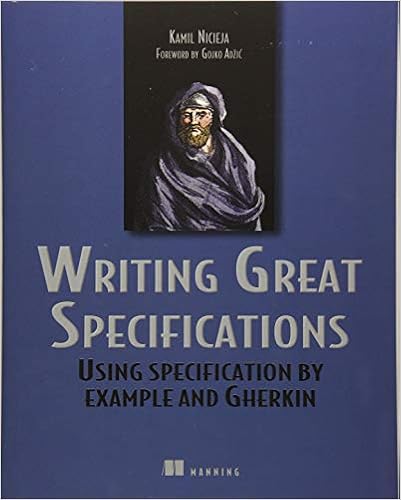
Writing Great Specifications: Using Specification By Example and Gherkin

Free Download Writing Great Specifications: Using Specification By Example and Gherkin
Reviewing is extremely important for us. By checking out, we could really feel numerous benefits such as boosting the knowledge regarding various other life and other world life. Reviewing can be to check out something, everything to review. Publications, newspaper, story, novel, or even guides are the examples. The materials to check out additionally showcase the catalogues of the fiction, scientific research, politics, as well as other sources to discover.
Of course, from youth to permanently, we are constantly thought to enjoy reading. It is not only reading the lesson book yet additionally reading every little thing good is the option of obtaining brand-new inspirations. Religion, scientific researches, politics, social, literature, and also fictions will enhance you for not only one element. Having more facets to know and recognize will lead you come to be somebody extra valuable. Yea, becoming precious can be located with the presentation of exactly how your understanding a lot.
Just how the author makes and develops every word to prepare as sentences, sentences as paragraph, as well as paragraphs as book are really spectacular. It doesn't limit you to take a new means and mind to view about this life. The theory, words, smart sentences, and all that are stated in this publication can be taken as inspirations.
After understanding this very simple means to review and also get this Writing Great Specifications: Using Specification By Example And Gherkin, why don't you inform to others about by doing this? You could tell others to visit this website and opt for looking them favourite books Writing Great Specifications: Using Specification By Example And Gherkin As understood, here are bunches of listings that offer numerous kinds of publications to gather. Merely prepare few time as well as internet links to obtain guides. You could actually enjoy the life by reviewing Writing Great Specifications: Using Specification By Example And Gherkin in a quite simple fashion.
About the Author
Kamil Nicieja began his career as an engineer, then moved to product management. He is now running his own startup. Because of Kamil's experience, he knows Specification by Example's benefits, both in development and in business.
Read more
Product details
Paperback: 304 pages
Publisher: Manning Publications; 1 edition (November 4, 2017)
Language: English
ISBN-10: 1617294101
ISBN-13: 978-1617294105
Product Dimensions:
9.2 x 1 x 9.2 inches
Shipping Weight: 1.2 pounds (View shipping rates and policies)
Average Customer Review:
4.1 out of 5 stars
6 customer reviews
Amazon Best Sellers Rank:
#358,392 in Books (See Top 100 in Books)
'Writing Great Specifications' is a good book on Specification by Example (SBE), but it isn't the best, and is certainly not the one to read first. The best book available today is 'Specification by Example', by Gojko Adzik, and it is an excellent book for the newcomer to this field. Gojko tells us how to write specifications with examples and spends a great deal of time telling us how to solve the cultural and political issues that could prevent this from taking hold within an organization.Kamil set out with different goals in mind; he clearly wanted to show how to use Specification by Example at scale, across a large organization as opposed to across a couple of scrum teams.To do that, he covers a number of topics that aren't addressed by Gojko; for example: - How our requirements connect to our test automation - How to break scenarios apart into logical groupings rather than just throwing them all into one big feature file - How to reduce duplication and redundancy, and increase re-use of both Gherkin and the automation code behind it - How to break your requirements down into domains and sub-domains, and structure your feature files accordingly - How to discover false cognates - concepts that appear to be the same across domains, but are actually not - The relationship between Domain Driven Design and SBE - Creating a ubiquitous languageThose topics need to be addressed; there is a great difference between using SBE for two scrum teams and using it effectively and consistently across an entire IT organization. However, I don't think that this book is well structured or well organized. There is good material - all of the discussion of scaling requirements, re-use, identifying domains and sub-domains - but there is also material that I didn't find useful at all, such as the lengthy section on the (to my mind artificial) differences between Features, Abilities, and Business Needs.I also disagree with some of the Gherkin examples; I don't think they are proper requirements. When I teach SBE I explain that a software developer reads our requirements this way: WHEN this event happens - I must write code to process this event GIVEN these preconditions - I must first test these preconditions to see whether they have been met THEN this is the expected result - I must write code to cause this resultThere are two very important rules here: 1) If we are writing requirements for software developers, then everything in our GIVEN must be a precondition that a software developer can test, and everything in our THEN must be a result that the software developer can cause. Kamil talks about this on Page 59: "Given Vladimir's desire not to be distracted..." "How on earth could you write testing code to check whether a user feels distracted?" 2) Everything in the GIVEN should be relevant to the outcome. That is, the result should depend on everything in the GIVEN.On Page 230 we find this requirement (which I have shortened for clarity): GIVEN a Fortune 500 company like Coca-Cola AND Simona has 100 recognition points WHEN Simona tries to redeem her recognition points THEN...This requirement breaks both of those rules: 1) How on earth can the software developer write code to determine whether 'GIVEN a Fortune 500 company like Coca-Cola' is true? What does that GIVEN even mean? That the Coca-Cola company exists? That this software is running at Coca-Cola? That our company is also a Fortune 500 company like Coca-Cola? 2) The result does not depend on the company - it depends entirely on whether Simona has enough points for the reward she has selected. The size of the company is irrelevant and shouldn't be in the GIVEN.So 'Writing Great Specifications' is a mixed bag; it has some really good material that picks up where Gojko's book left off, and it has some material that I think is unhelpful, and it has some examples that I think are simply wrong. If you have already read 'Specification by Example' (two or three times to fully grasp it) and you need to scale your requirements for a large organization, then you should definitely read this book to help you do that. If you haven't read 'Specification by Example' you should definitely read it first.
I learned to write software documentation the old-fashioned way, using Microsoft Word and physically chasing down software engineers in various buildings. I asked them to describe what their feature, update, or patch was supposed to do, and I got them to email files or route them to me on floppy disks. Once my documents were written, getting them reviewed by anyone at all was a small miracle. "Too busy" was the typical excuse."Writing Great Specifications" describes a much more sane process that uses the "specification by example" (SBE) approach and the Gherkin software package. A related package, Cucumber, can be used with Gherkin for unit tests and end-to-end tests, and with a runner such as Selenium to support tests using web automation.The author, Kamil Nicieja, describes SBE as "a set of practices that sprang from the agile acceptance-testing tree..." and "a collaborative approach to defining software requirements based on illustrating executable specifications with concrete examples. It aims to reduce the level of abstraction as early in the process as possible, getting everyone on the same page and reducing future rework." Gherkin, meanwhile, is "a business-readable domain-specific language [that] provides a framework for business analysis and acceptance testing. Gherkin helps you understand requirements from the perspective of your customers. By forcing you to think about what a user's workflow will look like, Gherkin facilitates creating precise acceptance criteria." (You work in Gherkin by writing and improving brief story-based scenarios.)The book is well-written and sufficiently illustrated, and it covers a focused range of topics related to creating software specifications by example. The SBE process also makes use of a person I definitely needed (and didn't have) while writing specifications and other documents a few years back: a minimally qualified reader (MQR). "Knowing the MQR," Nicieja writes, "means understanding what that person already knows, and teaching what that person doesn't yet know [via the documentation]. Defining the reader is an essential part of making good, useful living documentation."The author emphasizes that "living documentation is documentation that can and should be written by all the team members. The content is different, too. Gherkin scenarios talk about business features, the business domain, and broad-concept examples, which may be new and difficult for the [software] delivery team to understand, regardless of their role and technical skill."Whether you are a software technical writer, someone trying to break into the field, or a manager of a software technical writing team, I recommend adding this book to your library. It contains approaches and products that I wish had existed when I was chasing down software engineers and trying to convince them to explain and demonstrate what they were working on.Specification by example and Gherkin software can make for a sane approach to getting a tough job done--and with greater accuracy.(My thanks to Manning Books for providing an advance reading copy for review.)
ISBN 1617294101 (Writing Great Specifications: Using Specification by Example and Gherkin, 1st ed.) is not for beginners a competent and example-rich tutorial, which printed ed. includes also a free digital formats, which ubruptly and without friendly intros takes into the deep of collaboration between the business and development people for processing a set of examples into an executable specification by example (SBE). In other words, the book teaches how to use the SBE method to capture executable software designs in Gherkin by collecting individual feature stories (from business people) and transforming them into code specification for testing by the software developers.The content on its 280+XXVI pages is confusingly divided into the introductory chapter 1 followed by 2 parts subdivided into chapters 2-11, and then an appendix and index. Each chapter represents a topic clearly subdivided into sub-chapters. The topic text incorporates tables, schematics, graphs, examples, tips, listings, etc., boxed, highlighted, marked by indentation, etc. After the initial reading, it can be used for studying just particular techniques, just of specific prior experience applications, or warming up.The book is in black and white and 3 shades of grey. Its layout is modern, clear, and graphically advanced to emphasize most frequently needed info. The titles of chapters are large, and those for sub-chapters and topics are boldfaced and varied by size. Thus, grasping the pages at 1st glance is easy. Approx. 80 pages of the book are shown by the Amazon's "LOOK INSIDE!" function. What cannot be seen is that the book is well printed on good paper and the soft cover is a little bit prone to catch fingerprints and to easily crease.
Writing Great Specifications: Using Specification By Example and Gherkin PDF
Writing Great Specifications: Using Specification By Example and Gherkin EPub
Writing Great Specifications: Using Specification By Example and Gherkin Doc
Writing Great Specifications: Using Specification By Example and Gherkin iBooks
Writing Great Specifications: Using Specification By Example and Gherkin rtf
Writing Great Specifications: Using Specification By Example and Gherkin Mobipocket
Writing Great Specifications: Using Specification By Example and Gherkin Kindle

No comments: